As manufacturers begin planning for 2027, decisions about equipment, production capacity, and operational efficiency are becoming increasingly important.
Rising operating costs, staffing challenges, changing customer expectations, and the need for greater production flexibility continue to influence how manufacturers approach capital investments.
For many facilities, the question is no longer whether automation can improve operations. It’s where automation investments will deliver the greatest long-term value.
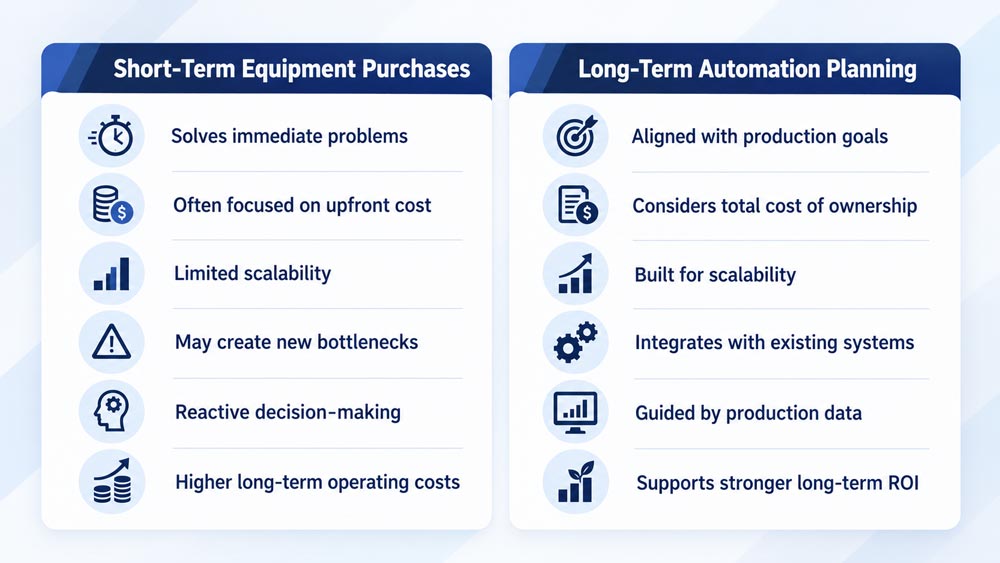
A new conveyor system, automated packaging solution, or material handling upgrade might solve an immediate production problem. However, the most successful investments do more than address today’s challenges. They improve efficiency, support future growth, and provide the flexibility to adapt as production requirements change.
Manufacturing automation planning for 2027 should focus on identifying production constraints, evaluating equipment scalability, measuring potential returns, and choosing solutions that can grow alongside the business.
Here’s what manufacturers should consider when developing their automation investment strategy for the coming year.
Why Manufacturing Automation Planning Matters for 2027
Manufacturing facilities face a difficult balancing act.
They need to increase productivity while controlling expenses, maintaining product quality, and making the most of their available workforce. At the same time, customer demand and production requirements can change quickly.
Investing in automation without a clear strategy can create new problems instead of solving existing ones.
For example, purchasing a faster packaging machine might seem like an obvious way to increase production. But if the conveyor system feeding that machine cannot maintain the necessary product flow, the additional capacity may go unused.
Similarly, replacing an older machine without considering future packaging formats could leave a facility facing another expensive upgrade just a few years later.
Effective industrial automation planning requires looking beyond individual pieces of equipment and evaluating how the entire production process works together.
Before committing to new equipment, manufacturers should understand:
- Which processes currently limit production capacity
- Where manual labor creates unnecessary operating costs
- How frequently equipment experiences downtime
- Whether existing systems can support increased production
- What changes in product sizes, packaging, or production volumes are expected
- How new equipment will integrate with existing operations
These questions help ensure automation investments support measurable operational improvements rather than simply replacing aging equipment.
Manufacturing Automation Trends to Consider for 2027
Several established manufacturing automation trends are influencing how facilities approach equipment upgrades and long-term planning.
While advanced robotics and artificial intelligence receive considerable attention, some of the most valuable improvements involve practical technologies that make existing production processes more efficient.
1. Flexible and Scalable Automation Systems
Manufacturers increasingly need equipment capable of handling different products, packaging formats, and production volumes.
A system designed around one specific product may perform well today but become restrictive when customer requirements change.
Flexible automation solutions can help facilities accommodate:
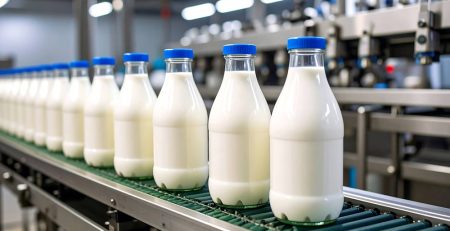
- Different bottle and container sizes
- Multiple packaging configurations
- Changes in production speed
- Additional product lines
- Future equipment expansions
For example, adjustable conveyor systems and product handling equipment can provide greater flexibility than systems designed around a single application.
The goal is to select equipment that supports current production requirements without unnecessarily limiting future opportunities.
2. Increased Focus on Material Handling Automation
Material handling remains an important opportunity for manufacturers looking to improve efficiency.
Tasks such as transferring containers, loading equipment, moving products between production stages, and preparing finished goods for packaging can consume significant labor.
When these processes depend heavily on manual handling, production becomes more vulnerable to staffing shortages, inconsistent cycle times, and repetitive physical demands.
Automated conveyors, product transfers, palletizing systems, and other material handling solutions can help create more predictable production flow.
Manufacturers evaluating these opportunities should consider the full financial impact, including labor utilization, overtime, product damage, and production capacity.
For a deeper look at these calculations, read The ROI of Automating Manual Material Handling Tasks.
3. Greater Use of Production Data
Industry 4.0 technologies continue to influence how manufacturers monitor equipment and make operational decisions.
Connected sensors, programmable controls, and production monitoring systems can provide valuable information about how equipment performs throughout the day.
Instead of relying entirely on operator observations or maintenance reports, facilities can use production data to identify recurring inefficiencies.
Common measurements include:
- Overall Equipment Effectiveness (OEE)
- Equipment downtime
- Production throughput
- Cycle times
- Product rejection rates
- Maintenance frequency
- Energy consumption
Collecting this information helps manufacturers make more informed decisions about maintenance, equipment upgrades, and future capital expenditures.
Importantly, facilities do not need to replace every machine to begin collecting useful production data.
In some cases, adding sensors, updating controls, or improving communication between existing systems can provide meaningful operational insights.
Which Automation Investments Deliver the Strongest ROI?
Not every automation project offers the same financial return.
The strongest opportunities are generally those that address recurring production problems, reduce unnecessary labor, or improve the performance of multiple processes.
Conveyor System Improvements
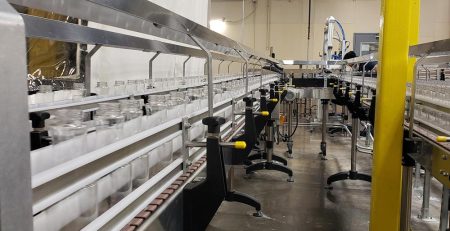
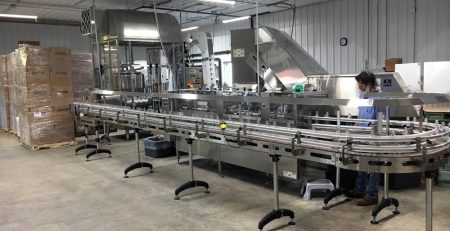
Conveyors are essential to maintaining consistent product flow throughout manufacturing and packaging operations.
However, older conveyor systems can become increasingly inefficient as production requirements change.
Common problems include excessive product accumulation, poor transfer points, frequent jams, inconsistent speeds, and unnecessary downtime.
Upgrading a conveyor system may improve overall production efficiency without requiring replacement of more expensive upstream or downstream equipment.
Potential improvements include:
- More efficient product transfers
- Better accumulation management
- Improved speed synchronization
- Reduced product damage
- Greater flexibility for different container sizes
- Lower maintenance requirements
Manufacturers should evaluate whether their existing conveyors are supporting or restricting production.
Our article, Is Your Conveyor System Costing You More Than You Think?, explains how hidden inefficiencies can increase operating expenses.
Facilities considering upgrades can also explore different conveyor system options to better understand available technologies.
Automated Packaging and Product Handling
Packaging automation can provide significant value when manual operations limit production speed or consistency.
Processes such as bagging, debagging, product orientation, packing, and container handling often become more demanding as production volumes increase.
Automating these processes can help manufacturers maintain consistent production rates while reducing repetitive manual tasks.
For example, an automated bagging or debagging system may reduce the amount of operator involvement required to prepare containers for production.
Similarly, automated product handling equipment can improve orientation and transfer consistency between different stages of the line.
The financial benefit depends on the application, but potential returns include improved throughput, reduced labor requirements, and fewer handling-related interruptions.
Manufacturers evaluating these opportunities can review available packaging and automation equipment to identify solutions suited to their production processes.
Eliminating Production Bottlenecks
Sometimes the most valuable automation investment is not a new machine. It’s improving the performance of equipment already installed.
A packaging line might include a high-speed filler, an efficient labeling system, and modern packing equipment. Yet a poorly designed transfer point between machines could prevent the entire line from reaching its intended capacity.
In this situation, improving product flow may deliver greater value than purchasing another high-speed machine.
Before making major capital investments, manufacturers should evaluate the complete production process and identify its most significant constraints.
Our guide, How to Identify Bottlenecks in Your Packaging Line Before They Impact Production, explains how throughput analysis, equipment observations, and production data can reveal opportunities for improvement.
Why Modular Automation Systems Make Sense for Long-Term Growth
One important consideration in industrial automation planning is whether equipment can be expanded or modified as production requirements change.
Modular automation systems are designed around individual components or sections that can be integrated into a larger production process.
Rather than requiring an entirely new system whenever capacity increases, modular designs may allow manufacturers to add or modify specific equipment.
For example, a facility might initially install a conveyor system that connects two existing production processes.
As demand increases, the manufacturer may need to add accumulation capacity, another product transfer, or an additional packaging station.
A modular design can make these changes easier to accommodate, provided the original system has sufficient capacity and compatible controls.
“A well-planned automation strategy considers current production constraints, expected growth, equipment compatibility, and long-term operating costs. By approaching 2027 with a clear understanding of these factors, manufacturers can make capital investments that improve productivity today while supporting more efficient operations in the years ahead.”
Benefits of Modular Automation
Modular systems can offer several advantages:
Lower disruption during expansion: Individual sections may be modified without replacing the entire production line.
Greater production flexibility: Equipment can sometimes be reconfigured to support different products or processes.
More manageable capital investments: Manufacturers may be able to implement improvements in phases rather than funding one large project.
Simplified maintenance: Standardized components can make troubleshooting and replacement easier.
Longer equipment usefulness: Systems that can adapt to changing requirements may remain productive for more years.
Modular equipment is not automatically the best solution for every application. However, manufacturers should consider future expansion requirements when evaluating new automation investments.
Build Scalability Into Your Automation Investment Strategy
Scalability means more than purchasing equipment with a higher maximum production speed.
A truly scalable automation system should support changes in capacity, product requirements, facility layout, and operational processes.
For example, a manufacturer currently producing 100 containers per minute may anticipate increasing production to 150 containers per minute over the next several years.
Purchasing equipment designed only for today’s output could create an expensive limitation when demand increases.
However, buying equipment with substantially more capacity than necessary can also tie up capital without delivering an immediate return.
The right approach is to evaluate realistic growth projections and identify which system components should accommodate future expansion.
Questions to Ask Before Purchasing Equipment
Manufacturers should consider:
- Can the equipment support higher production volumes?
- Will it accommodate different product sizes or packaging formats?
- Can additional conveyor sections or automation equipment be integrated?
- Are replacement parts and technical support readily available?
- Can the system communicate with existing production equipment?
- Will future expansion require major facility modifications?
Answering these questions during the planning process can prevent unnecessary equipment replacement and integration costs.
Working with experienced engineering and integration professionals can also help identify potential limitations before equipment is purchased.
How Industry 4.0 Data Can Improve Automation ROI
One of the most valuable developments in manufacturing automation is the ability to make investment decisions using actual production data.
Historically, facilities often relied on maintenance records, operator feedback, and production totals to evaluate equipment performance.
Those measurements remain useful, but connected equipment can provide a more detailed understanding of how individual processes operate.
For example, production monitoring might reveal that a conveyor stops for several minutes each hour because of recurring accumulation problems.
Although each interruption seems minor, the combined effect could represent substantial lost production time over an entire year.
Without reliable data, these interruptions may be overlooked.
With better visibility, manufacturers can estimate the cost of the problem and compare it against the investment required to correct it.
Start With the Data That Matters Most
Facilities do not need complicated analytics platforms to benefit from production monitoring.
A practical starting point is identifying a few measurements directly connected to operational performance.
These might include:
- Actual units produced per hour
- Unplanned downtime by equipment
- Frequency of product jams
- Time required for changeovers
- Product rejection rates
- Maintenance-related stoppages
Once this information is collected consistently, manufacturers can establish performance benchmarks and measure improvements after implementing automation upgrades.
The most useful data is information that helps teams make better decisions.
Avoid Short-Term Purchasing Decisions That Create Long-Term Costs
When equipment fails or production demand increases unexpectedly, manufacturers may feel pressure to purchase the fastest available solution.
Although urgent repairs and replacements are sometimes necessary, short-term purchasing decisions can create expensive limitations.
For example, selecting a replacement conveyor based entirely on purchase price may overlook important considerations such as maintenance requirements, product compatibility, controls integration, and future capacity.
Similarly, purchasing an automated machine without evaluating surrounding equipment could introduce new bottlenecks.
Evaluate Total Cost of Ownership
Instead of comparing equipment prices alone, manufacturers should consider total cost of ownership.
This includes:
- Initial equipment purchase
- Engineering and system design
- Installation and integration
- Employee training
- Maintenance and replacement parts
- Energy consumption
- Expected downtime
- Future modification costs
- Equipment service life
A system with a higher initial price may provide better long-term value if it requires less maintenance, improves productivity, or accommodates future production changes.
However, higher-priced equipment does not automatically deliver a stronger return.
The decision should be supported by realistic performance expectations and measurable financial benefits.
Create a Practical Automation Roadmap for 2027
Manufacturers do not need to automate every process at once.
A phased approach can help facilities prioritize investments while managing capital expenditures and operational disruption.
Step 1: Evaluate Current Production Performance
Begin by reviewing existing equipment, production rates, maintenance records, and labor requirements.
Identify recurring problems that reduce productivity or increase operating expenses.
Step 2: Prioritize High-Impact Opportunities
Focus on improvements that address measurable constraints.
Projects that reduce downtime, improve throughput, or eliminate repetitive manual tasks may provide stronger returns than upgrades based primarily on equipment age.
Step 3: Establish Financial Expectations
Estimate the total project investment and expected annual benefits.
Include installation, integration, maintenance, training, and other operating costs.
Calculate potential payback periods using realistic assumptions.
Step 4: Plan for Future Expansion
Consider expected production growth, new products, packaging changes, and potential facility modifications.
Select equipment that supports both immediate requirements and reasonable future needs.
Step 5: Coordinate Engineering and Installation
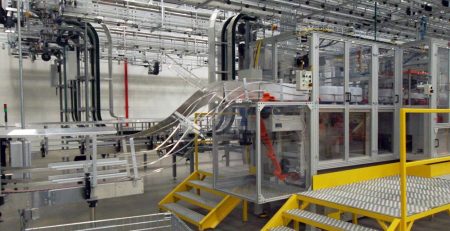
Automation projects often involve multiple pieces of equipment that must operate together.
Proper engineering and design can help ensure new systems integrate with existing operations.
Installation schedules should also account for production requirements, equipment testing, employee training, and commissioning.
Step 6: Measure Results After Implementation
Once equipment is operating, compare actual performance against the original project goals.
Track throughput, downtime, labor requirements, maintenance costs, and other relevant metrics.
This information can help improve future automation planning and investment decisions.
Preparing for 2027 Starts With Understanding Your Production Needs
The best automation investments are not necessarily the most advanced or expensive.
They are the solutions that address real operational challenges while creating opportunities for future growth.
For some manufacturers, that might mean replacing an inefficient conveyor system. For others, it could involve automating repetitive material handling tasks, improving packaging equipment, or adding production monitoring capabilities.
The key is evaluating each investment within the context of the entire facility.
A well-planned automation strategy considers current production constraints, expected growth, equipment compatibility, and long-term operating costs.
By approaching 2027 with a clear understanding of these factors, manufacturers can make capital investments that improve productivity today while supporting more efficient operations in the years ahead.
FAQs About Manufacturing Automation Planning for 2027
Manufacturers should consider flexible automation systems, improved material handling, connected equipment, production data collection, and modular equipment designs. These technologies can help improve productivity, reduce downtime, and support future production requirements.
Automation investments with strong ROI potential often include conveyor improvements, automated material handling, packaging equipment upgrades, and solutions that eliminate production bottlenecks. The actual return depends on labor requirements, downtime, production volumes, maintenance costs, and the total investment.
Manufacturers should begin evaluating major automation projects several months before the intended installation date. Complex projects may require additional time for engineering, equipment procurement, integration, testing, and employee training. Planning during the previous year’s capital budgeting process can help establish realistic timelines.
A modular automation system uses individual equipment components or sections that can be integrated, expanded, or modified. Modular designs may allow manufacturers to increase production capacity or accommodate new processes without replacing an entire system.
Manufacturers can estimate automation ROI by comparing the annual net financial benefits against the total project investment. Benefits may include reduced labor costs, lower downtime, improved throughput, less product damage, and reduced maintenance expenses. Ongoing operating costs should also be included.
Yes. Depending on the equipment’s condition and compatibility, manufacturers may be able to improve performance through conveyor modifications, updated controls, additional sensors, improved product transfers, or targeted automation upgrades. An equipment assessment can help determine whether upgrading or replacing a system offers better long-term value.
Industry 4.0 uses connected equipment, sensors, data collection, and digital monitoring to improve visibility into production processes. Manufacturers can use this information to identify downtime, measure throughput, monitor equipment performance, and prioritize automation investments based on actual operating conditions.
Want to Know More About Manufacturing Automation Planning?
Evaluating equipment upgrades or preparing for increased production in 2027?
The right automation solution starts with understanding your facility’s existing processes, production requirements, and long-term goals.
Explore our conveyor systems, automation equipment, and engineering and integration services to learn more about available solutions.
You can also contact our team or call (616) 874-4041 to discuss your production needs.