Moving products, containers, cases, pallets, and materials from one point to another is a basic part of manufacturing. It can also be one of the biggest sources of hidden cost.
When employees spend hours lifting, carrying, transferring, stacking, loading, unloading, or manually moving products between processes, manufacturers are paying for more than the labor required to complete the task. They may also be absorbing overtime, injuries, inconsistent production rates, bottlenecks, product damage, and the cost of trying to hire enough people to keep the process running.
That is why material handling automation is increasingly viewed as more than a way to reduce headcount. Done correctly, automation can create measurable financial returns while making production more predictable and allowing employees to focus on work where people provide more value.
What is the ROI of material handling automation? The return typically comes from a combination of lower labor requirements, reduced overtime, fewer ergonomically demanding tasks, increased throughput, improved consistency, less product damage, and the ability to maintain production despite staffing shortages.
The exact automation ROI depends on the application, but manufacturers can evaluate it by comparing those annual financial benefits against the total cost of designing, purchasing, installing, operating, and maintaining the automated system.
Why Manual Material Handling Is More Expensive Than It Looks
A manual task can appear inexpensive when the only number being considered is an employee’s hourly wage.
The true cost is much higher.
According to the U.S. Bureau of Labor Statistics, employer compensation costs in manufacturing averaged approximately $48 per hour in March 2026 when wages and benefits were combined. Transportation and warehousing employers faced similarly high total compensation costs.
And direct compensation is only one piece of the calculation.
Manual material handling can also create costs associated with:
- Overtime when staffing levels cannot meet production demands
- Recruiting and training replacement employees
- Workers’ compensation claims
- Absenteeism and restricted-duty work
- Production slowdowns
- Product damage
- Inconsistent cycle times
- Bottlenecks between processes
- Employee turnover
- Lost production when positions remain unfilled
A task that requires one or two employees per shift can therefore represent a significant annual operating expense.
This is one reason the manufacturing automation benefits become much clearer when companies evaluate an entire process instead of simply comparing the price of equipment against an employee’s hourly wage.
How Do You Calculate Automation ROI?
A basic automation ROI calculation starts with two numbers: the investment required to automate the process and the financial benefit the system is expected to produce.
A simple formula is:
Automation ROI = (Annual Net Financial Benefit ÷ Total Automation Investment) × 100
Manufacturers can also calculate payback period:
Payback Period = Total Automation Investment ÷ Annual Net Financial Benefit
The challenge is determining what should be included in the financial benefit.
Labor is usually the most obvious component, but a realistic calculation should also consider overtime, increased capacity, injury reduction, product quality, scrap, downtime, maintenance, and other measurable changes.
Start With Fully Loaded Labor Costs
Suppose a repetitive material handling task requires the equivalent of 1.5 full-time employees each year.
Using a fully loaded labor cost of approximately $48.27 per hour as a general manufacturing benchmark based on BLS employer compensation data:
$48.27 × 2,080 hours = approximately $100,400 per full-time employee
The annual labor capacity represented by 1.5 employees would therefore be approximately:
$100,400 × 1.5 = $150,600
That does not necessarily mean the company will eliminate 1.5 positions.
In many manufacturing environments, automation allows those employees to be reassigned to production, maintenance, quality, machine operation, or other positions that are harder to fill. The financial value may come from avoiding future hiring, reducing overtime, increasing output, or allowing existing employees to accomplish more.
That distinction matters when calculating a realistic ROI.
A Simple Material Handling Automation ROI Example
Consider a manufacturer evaluating a $300,000 automated material handling system.
After studying the existing process, the company determines that the system could provide approximately:
$150,600 in recovered labor capacity
$20,000 in reduced overtime
$15,000 in avoided injury, product damage, and related costs
$30,000 in additional production value
That creates approximately $215,600 in annual financial benefit.
If the system requires $20,000 per year for maintenance, energy, spare parts, and other operating expenses, annual net benefit becomes approximately:
$195,600
The estimated annual automation ROI would be:
$195,600 ÷ $300,000 × 100 = approximately 65%
The estimated payback period would be:
$300,000 ÷ $195,600 = approximately 1.53 years
That works out to roughly 18 months.
This is only an illustrative example. Every operation will have different labor costs, production rates, equipment requirements, and financial assumptions.
It does demonstrate why a project that initially looks expensive can become much easier to justify once the full cost of the manual process is documented.
Labor Savings Are Only Part of the ROI
Labor is often the easiest benefit to quantify, but focusing on labor alone can underestimate the value of material handling automation.
For many manufacturers, some of the strongest returns come from improvements elsewhere in the process.
Reducing the Impact of Staffing Challenges
Finding employees for repetitive material handling jobs can be difficult, particularly when the work involves constant lifting, carrying, stacking, or repetitive motion.
When the process depends on having a specific number of employees on the floor, an open position can quickly become a production problem.
Supervisors may need to move employees between departments. Overtime increases. Production schedules become harder to maintain. Existing employees are asked to do more.
Automation changes that equation.
A conveyor, robotic palletizer, depalletizer, automated packing system, or other material handling solution can provide consistent production without depending on whether every manual position is staffed on every shift.
This does not eliminate the need for skilled employees. Instead, it can reduce dependence on people for repetitive tasks while allowing manufacturers to use available employees in positions that require judgment, problem-solving, machine knowledge, quality control, or technical skills.
That ability to do more with the workforce already available is one of the most important manufacturing automation benefits.
Reducing Ergonomic and Injury Risks
Manual material handling can also carry significant physical risk.
The Occupational Safety and Health Administration identifies lifting, lowering, pushing, pulling, repetitive movement, awkward postures, and other physical demands as factors that can contribute to work-related musculoskeletal disorders.
The Bureau of Labor Statistics also tracks hundreds of thousands of private-industry cases involving overexertion, repetitive motion, and other bodily conditions that can lead to days away from work, job restrictions, or transfers.
Those injuries can create costs far beyond the initial medical expense.
“The cost of continuing to perform a task manually is often scattered across payroll, overtime, workers’ compensation, recruiting, training, lost capacity, damaged products, maintenance, and production reports. That is why manufacturers evaluating material handling automation should compare the investment against the full operating cost of the current process.”
An injured employee may miss work, operate under restrictions, require another employee to cover the position, or experience reduced productivity after returning.
Automation can help remove some of those repetitive physical demands from the process.
For example, instead of requiring an employee to repeatedly lift cases from a conveyor and stack them on pallets, a robotic or automated palletizing system can perform the repetitive motion while employees supervise production and manage exceptions.
The National Institute for Occupational Safety and Health recommends ergonomic improvements and mechanical assistance to reduce the physical demands associated with manual material handling. Its guidance includes the use of conveyors, lift-assist devices, work-positioning equipment, and redesigned material handling processes.
NIOSH also provides a Revised NIOSH Lifting Equation that employers and safety professionals can use to evaluate certain manual lifting tasks and identify jobs that may expose workers to increased physical stress.
Reducing injuries is good for employees. It can also strengthen the financial case for automation.
Increasing Throughput Without Continuously Adding Labor
Another major source of automation ROI is production capacity.
Imagine that a manual transfer process can reliably handle 20 units per minute. Upstream equipment is capable of producing 30, but operators cannot consistently move products quickly enough to keep up.
The material handling task has now become the bottleneck.
Manufacturers have a few options.
They can add another employee. They can increase overtime. They can slow the upstream process. Or they can redesign how products move through the line.
The right material handling automation system can help synchronize different stages of production so that products continue moving at a controlled and predictable rate.
Even a modest improvement in throughput can have a large financial impact when it occurs across thousands or millions of units annually.
The value becomes even greater when automation prevents a downstream process from starving or an upstream machine from stopping because products have nowhere to go.
Automation should therefore be evaluated based on the performance of the entire production line, not only the task being automated.
Improving Production Consistency
People naturally work at different speeds.
Production rates can change throughout a shift because of fatigue, breaks, shift changes, experience levels, staffing, and other factors.
Automation creates a more repeatable process.
A properly designed conveyor system can maintain predictable product flow. An automated palletizer can follow the same stacking pattern every cycle. Automated packaging equipment can repeat the same motion throughout a production run.
That consistency makes production easier to plan.
It may also reduce downstream interruptions, handling errors, improperly stacked loads, and product damage.
These improvements can be harder to quantify than direct labor savings, but they should still be considered when evaluating automation ROI.
Where Does Material Handling Automation Make the Most Sense?
Not every manual task needs to be automated.
The best opportunities are usually tasks that are repetitive, frequent, predictable, physically demanding, difficult to staff, or creating a measurable constraint elsewhere in production.
Several common applications illustrate where warehouse automation and manufacturing automation can produce strong returns.
Conveying Products Between Processes
Employees should not have to repeatedly carry or manually move products between equipment when the path is consistent and predictable.
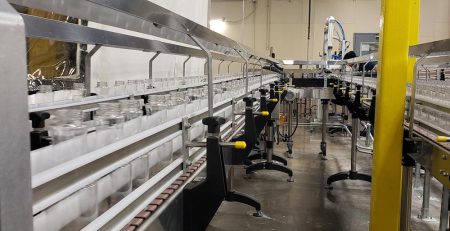
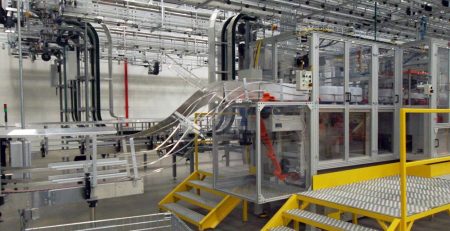
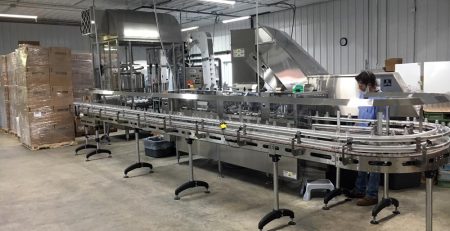
Cable conveyors, tabletop conveyors, MatTop conveyors, accumulation systems, elevators, transfers, and other conveyor technologies can continuously move products through the facility while maintaining the flow required by upstream and downstream processes.
The ROI may come from labor reduction, improved line balance, reduced product handling, and higher throughput.
Automated Palletizing and Depalletizing
Palletizing is one of the clearest examples of a repetitive material handling process.
Employees may perform hundreds or thousands of lifts during a shift while repeatedly bending, reaching, turning, and stacking.
Automated palletizers can reduce that physical workload while providing repeatable pallet patterns and predictable cycle times.
Depalletizing systems can provide similar benefits at the beginning of a production or packaging process.
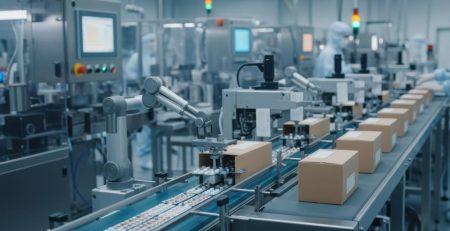
Automated Packing and Product Handling
Manual case packing, tray packing, bagging, debagging, product orientation, and container handling can consume substantial labor when production volumes increase.
Automating these functions can help manufacturers maintain higher line speeds without increasing staffing at the same rate.
Moving Work in Process
In larger plants and warehouses, employees may spend significant time simply transporting materials.
Conveyors, automated guided vehicles, autonomous mobile robots, and other warehouse automation technologies can reduce unnecessary travel and create a more structured flow of materials through the facility.
The goal is not automation for its own sake. It is removing transportation and handling steps that do not add value to the product.
Automation Can Help Manufacturers Grow Without Matching Labor Growth
One of the most compelling reasons to automate is that production growth no longer has to require a proportional increase in labor.
If increasing production by 25% means hiring 25% more material handling employees, growth can become difficult when qualified workers are unavailable.
Automation can change the relationship between output and staffing.
A company may be able to increase production while keeping its material handling workforce relatively stable. Existing employees can then support larger production volumes because machines handle more of the repetitive movement.
Manufacturers across North America continue to invest heavily in robotics and automation. According to the Association for Advancing Automation, North American companies ordered 8,940 robots valued at $622 million during the second quarter of 2026. First-half 2026 orders reached nearly 18,000 units.
The same report showed automation demand extending beyond the automotive industry into areas such as food and consumer goods, electronics, life sciences, metals, plastics, and other manufacturing sectors.
For many companies, automation is becoming part of a broader strategy for improving capacity and resilience rather than simply replacing manual labor.
How to Find Your Best Automation Opportunities
The best place to start is not by choosing a robot, conveyor, or piece of equipment.
Start with the problem.
Walk through the production process and identify where employees repeatedly lift, carry, push, pull, stack, transfer, orient, pack, or transport products.
Then ask:
How many employee hours does this process require each week?
How much overtime does it create?
Is the position difficult to keep staffed?
Does the process cause upstream or downstream equipment to stop?
Could production run faster if this step were improved?
Are employees performing repetitive or ergonomically demanding movements?
Does manual handling contribute to damaged products or inconsistent output?
What happens when the employee assigned to the task is absent?
Those questions make it easier to separate automation opportunities with meaningful financial potential from projects that may be technically interesting but difficult to justify.
Look Beyond the Initial Price of Automation
The price of an automated system is easy to see.
The cost of continuing to perform a task manually is often scattered across payroll, overtime, workers’ compensation, recruiting, training, lost capacity, damaged products, maintenance, and production reports.
That is why manufacturers evaluating material handling automation should compare the investment against the full operating cost of the current process.
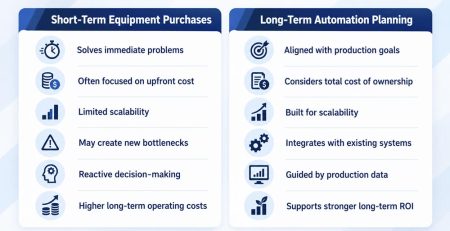
The strongest automation projects solve several problems at once.
They reduce repetitive labor. They improve safety. They increase throughput. They make production more consistent. They reduce dependence on difficult-to-fill positions. And they create additional capacity without requiring the workforce to grow at the same rate.
When those benefits are measured together, the return can be much larger than labor savings alone suggest.
FAQs About the ROI of Manufacturing Automation
Material handling automation uses equipment and control systems to move, transfer, position, store, pack, stack, or otherwise handle products with less manual labor. Examples include conveyors, robotic palletizers, depalletizers, automated packing systems, lifts, transfers, and mobile robots.
Automation ROI can be calculated by dividing the annual net financial benefit produced by the system by the total project investment and multiplying by 100. Companies should consider labor, overtime, throughput, injury reduction, product damage, downtime, maintenance, energy, and other measurable costs and benefits.
There is no universal target because acceptable payback periods depend on the company’s capital requirements, application, risk tolerance, equipment life, and strategic objectives. Projects with significant labor, safety, or capacity benefits may justify longer payback periods than projects based on labor savings alone.
No. Many manufacturers use automation to avoid additional hiring, reduce overtime, address open positions, or redeploy employees to higher-value work rather than eliminate positions.
High-volume, repetitive, predictable tasks are often the strongest candidates. Examples include transferring products between machines, palletizing, depalletizing, case handling, container handling, packing, product orientation, and moving materials over consistent routes.
Yes. Automation and mechanical assistance can reduce employee exposure to repetitive lifting, carrying, pushing, pulling, bending, reaching, and other ergonomic risk factors. The effectiveness depends on the specific task and how the automated system is designed.
Common warehouse automation benefits include reduced manual travel, lower labor requirements, more consistent material flow, improved throughput, fewer repetitive handling tasks, better space utilization, and greater ability to handle higher volumes without proportional increases in staffing.
Start by measuring how much labor the task requires, its fully loaded cost, overtime, injury risk, downtime, throughput limitations, product damage, and the impact of staffing shortages. These figures can then be compared against the cost and expected performance of an automated solution.
Talk to Our Team
If manual material handling is limiting production or consuming more labor than it should, Automation Ideas can help evaluate the process and develop a customized solution. From conveyor systems and product handling to palletizing, packing, and custom automation, the right system starts with understanding how materials need to move through your operation.
If you are interested in our automation equipment, please contact us here or give our dedicated support team a call at (616) 874-4041.