Late Q4 and early Q1 often bring production spikes for many bottling operations. From holiday-driven demand for beverages to increased household goods production in preparation for retail resets, manufacturers face heightened pressure to move more product with speed, accuracy, and minimal downtime. During these peak production months, the performance of your conveyor system plays a pivotal role in maintaining throughput and meeting customer deadlines.
Whether you’re managing water, juice, detergent, or personal care bottles, choosing the right conveyor system—and optimizing its layout—can be the difference between a smooth season and costly bottlenecks. This guide explores the essential factors in selecting and configuring conveyor systems for bottling lines operating under seasonal demand pressure.
1. Understanding Your Peak Season Demands
Before selecting a conveyor system, it’s critical to assess your actual production demands during peak months. Ask yourself:
- What is the target output per shift or day?
- How many different bottle sizes and SKUs will run on the line?
- Are changeovers frequent?
- What are the upstream and downstream constraints (filling, capping, labeling, packaging)?
- How much space is available for expansion or reconfiguration?
This data will help define the system requirements for speed, flexibility, accumulation, and control.
2. Conveyor Types for Bottling Lines
Different conveyor designs offer different advantages depending on your product type, line speed, and operating environment. Some of the most common options include:
Tabletop Chain Conveyors
- Ideal for lightweight bottles (PET, HDPE)
- Smooth, continuous motion
- Easy to clean and sanitize
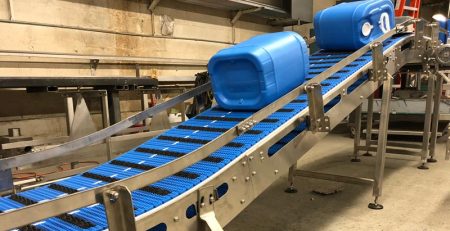
MatTop (Modular Plastic Belt) Conveyors
- Suitable for heavier or unstable bottles
- Offers better grip and support for odd-shaped containers
- Can handle accumulation without slippage
Air Conveyors (for empty PET bottles)
- Use air pressure to move lightweight bottles
- Extremely fast and efficient for high-speed bottling
Belt Conveyors
- Versatile and cost-effective
- Best for transferring full bottles or packaged goods downstream
3. Line Layout Considerations During High Volume
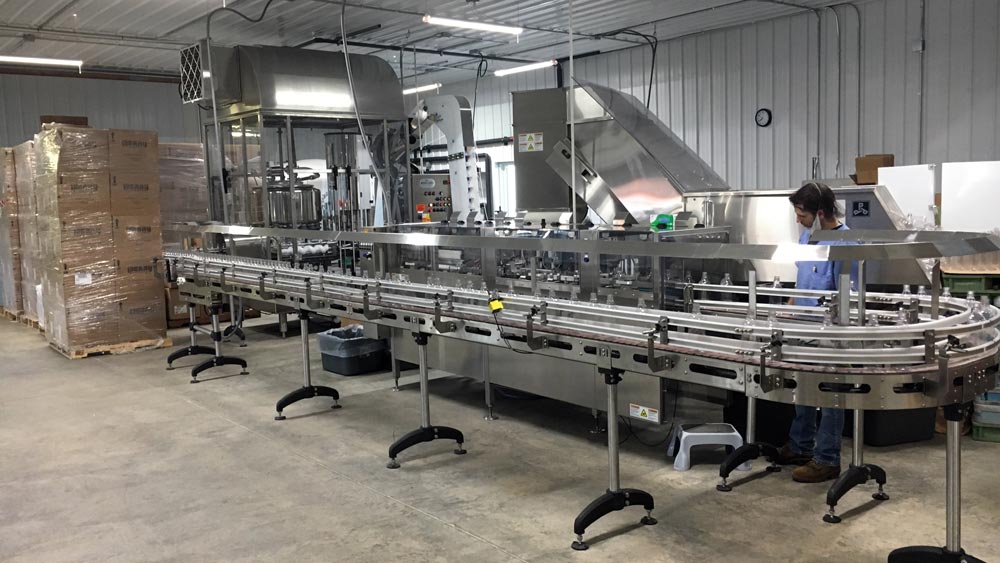
In peak season, the layout of your conveyor system must support uninterrupted flow while accommodating volume surges.
Straight Runs
- Ideal for maintaining speed
- Fewer curves mean less bottle instability and fewer jams
Curved Sections and Transfers
- Must be designed carefully to avoid tipping or misalignment
- Use side guides and product-specific transitions
Inclines and Declines
- Often needed to transition between processing zones
- Require secure grip and consistent bottle orientation
Conveyor Elevation Systems
- Help navigate floor space constraints
- Create room for secondary packaging or palletizing underneath
Well-planned layouts reduce manual intervention and allow operators to focus on quality checks and line efficiency.
4. Accumulation Strategies for Bottling Lines
Peak season production spikes often mean more frequent stoppages due to changeovers, maintenance, or upstream delays. Accumulation zones are critical for absorbing these slowdowns without halting the entire line.
“By selecting the appropriate conveyor type, layout, accumulation strategy, and control integration, manufacturers can eliminate bottlenecks, reduce downtime, and improve throughput when it matters most.”
Types of Accumulation Conveyors:
- Single-File Accumulators – Maintain bottle orientation; ideal for inline labeling and coding.
- Mass Flow Accumulators – Allow bottles to move freely and build up; best for buffering between inconsistent equipment speeds.
- Spiral Accumulators – Save space by accumulating vertically.
Key Considerations:
- Make sure accumulators are long enough to buffer expected downtime.
- Use sensors and backpressure control to manage bottle flow.
- Balance accumulation capacity between upstream and downstream equipment.
5. Modular Systems for Flexibility and Growth
In high-demand seasons, flexibility is key. Modular conveyor systems allow for quick changes in line configuration, easy scaling, and faster maintenance.
Benefits of Modular Conveyor Design:
- Easily add or remove sections to adjust line length
- Reconfigure lines for different product formats
- Replace worn parts without full line shutdowns
For facilities with limited floor space or evolving product lines, modularity ensures your bottling operation can adapt to short-term spikes and long-term growth.
6. Smart Controls and Line Synchronization
Modern conveyor systems are only as good as the controls that manage them. During peak production months, intelligent control systems help maintain uptime and throughput by coordinating the entire line.
Look for systems that offer:
- PLC-based automation with remote monitoring
- Variable speed drives to manage line flow
- Integration with filler, capper, and labeler controls
- Real-time diagnostics and fault alerts
Line synchronization reduces start/stop cycles and keeps bottle flow consistent, reducing risk of jams and damage.
7. Sanitation and Maintenance in High-Output Environments
With increased output comes increased wear and the need for more frequent cleaning. Choose conveyor components and layouts that facilitate fast maintenance and sanitation.
Tips for peak season readiness:
- Select corrosion-resistant materials (stainless steel, UHMW)
- Use tool-less removal parts for quick access
- Implement predictive maintenance schedules
- Train operators on daily checks during extended shifts
Clean, well-maintained conveyors ensure better product quality and reduce unplanned downtime during your busiest months.
8. Safety and Ergonomics
Fast-moving production environments increase the risk of accidents. When upgrading or expanding conveyor systems for peak season, consider how they affect worker safety and ergonomics.
Key features to prioritize:
- Guarding on moving parts
- Emergency stop pull cords and buttons
- Clear walkways and access points
- Noise-reducing materials in high-speed zones
Creating a safe and efficient work environment supports higher morale and minimizes seasonal labor disruptions.
9. Customization for Product-Specific Needs
Different bottle shapes, caps, and materials may require unique conveyor solutions. Slippery bottles, tall unstable containers, or specialty caps (e.g., pumps or sprayers) need tailored guide rails, gripper belts, or orientation systems.
Working with experienced integrators or OEMs ensures your system can handle:
- Neck-handling for air conveyors
- Pressure-sensitive labels
- Multi-format bottle changeovers
- Orientation for barcodes or branding
Customization leads to fewer stoppages and smoother operations during time-sensitive runs.
Optimize Your Packaging Line Now for Seasonal Success
Peak production months bring opportunity—and pressure—for bottling operations. The right conveyor system can help you rise to the challenge, ensuring smooth, high-speed movement of bottles from start to finish.
By selecting the appropriate conveyor type, layout, accumulation strategy, and control integration, manufacturers can eliminate bottlenecks, reduce downtime, and improve throughput when it matters most. Modular systems and smart controls also allow you to remain agile during seasonal shifts and scale with long-term growth.
Start planning ahead of your next seasonal surge. With the right conveyor system in place, you’ll not only meet the demand—you’ll exceed it.
If you are interested in our automation equipment, please contact us here or give our dedicated support team a call at (616) 874-4041.